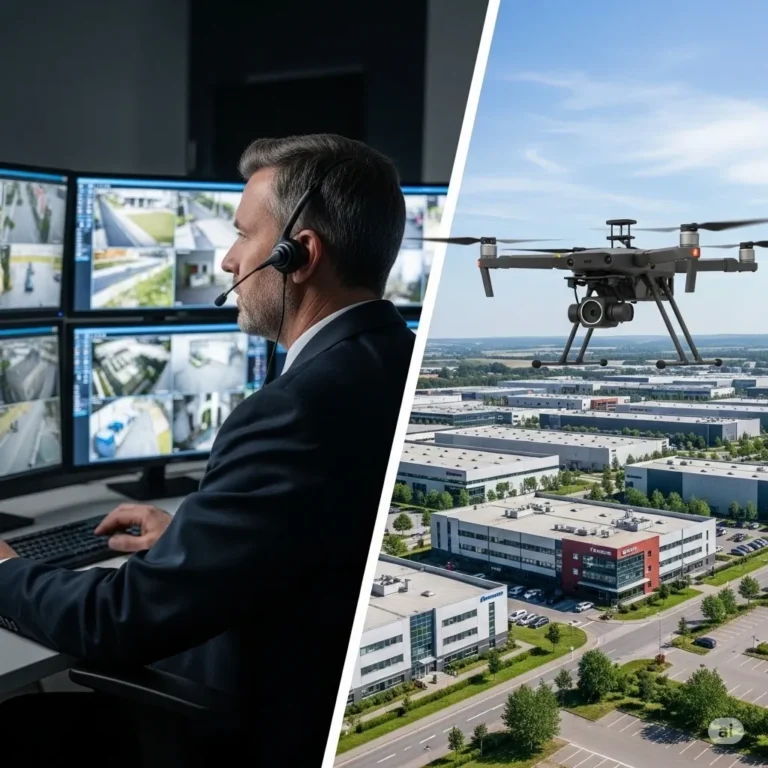
The Global State of Private Security in 2026
The Global State of Private Security in 2026
What’s Really Changing in Our Industry
The private security sector in 2026 is no longer defined by guards, gates, and patrols. It is defined by data, convergence, resilience, and AI‑driven decision‑making. Across every region, clients are demanding more capability, more accountability, and more integration between physical and digital security.
This shift is reshaping how training institutions, security companies, and national regulators operate — and it is redefining what private security in 2026 must deliver: new expectations for professionalism, governance, and measurable outcomes.
Hybrid Threats Are Now the Global Norm
Security leaders worldwide report that threats are no longer purely physical or purely cyber — they are hybrid, blending intrusion, digital compromise, and operational disruption. Attackers increasingly exploit the fact that physical environments are digitally controlled: access systems, cameras, sensors, industrial automation, and private networks.
This means private security personnel must now understand:
- digital‑physical attack chains
- how cyber vulnerabilities create physical risks
- how to operate in environments where systems can be manipulated remotely
Training models that ignore this convergence are already outdated.
AI Is Reshaping Security Faster Than Any Other Technology
Artificial intelligence is the single most disruptive force in the global security industry. The Security Industry Authority and international bodies identify AI as a top megatrend for 2026, influencing everything from alarm monitoring to SOC operations. For any organisation assessing private security in 2026, the ability to combine artificial intelligence with skilled human oversight has become a defining competitive advantage rather than an optional extra.
Key AI impacts include:
- AI‑driven video analytics
- automated anomaly detection
- predictive threat modelling
- autonomous patrol robots
- AI‑supported reporting and compliance
This is shifting the industry from manpower‑heavy models to technology‑enabled, intelligence‑driven operations.
Convergence of Safety, Cyber, and Physical Security
Across Europe and other regions, organisations are moving toward a “resilience + convergence” model — integrating fire safety, cybersecurity, business continuity, and physical security into unified systems.
This is driven by:
- IoT sensors
- unified platforms (PSIM / SOC)
- remote supervision
- stricter regulatory frameworks (e.g., NIS2, CER, AI Act)
Clients now expect private security providers to deliver measurable outcomes, not just hours on a rota.
Regulators Are Raising Standards Worldwide
Governments are tightening expectations around:
- training
- certification
- incident reporting
- supply chain security
- data protection
- operational resilience
In Europe, NIS2 and CER frameworks are forcing organisations to formalise risk management and resilience.
This global tightening of standards is pushing the industry toward:
- accredited training
- documented governance
- transparent oversight
- professionalisation of the workforce
Countries without strong training frameworks are now under pressure to modernise.
Robotics, Drones, and Autonomous Systems Are Expanding
Autonomous patrol robots, drone surveillance, and anti‑drone systems are becoming mainstream in Europe and Asia.
These technologies are not replacing guards — they are augmenting them, creating hybrid teams where humans handle judgment and escalation while machines handle:
- perimeter sweeps
- anomaly detection
- hazardous environments
- night‑time monitoring
Training institutions must now prepare personnel to operate alongside autonomous systems.
Cloud, IT Integration, and Data‑Driven Security
Security systems are increasingly cloud‑based, and IT departments now play a major role in security decision‑making.
This shift requires:
- stronger digital literacy
- understanding of cloud platforms
- data‑driven decision‑making
- integration between IT and security teams
Security officers are becoming operators of digital systems, not just physical responders.
What This Means for Training Institutions
Globally, the industry is moving toward:
- academically governed training
- national qualification frameworks
- blended physical‑digital competencies
- scenario‑based assessment
- compliance‑aligned governance
Training centres that cannot deliver this level of structure will fall behind. Those that can — especially in emerging markets — will become national leaders. It is exactly why we chose to base our academy in Uganda; you can read more about our approach to security training in Uganda and East Africa.
Why This Matters for Uganda and East Africa
East Africa is entering the same transformation curve seen in Europe and the Middle East. The region needs:
- nationally aligned training
- international standards
- governance‑driven institutions
- compliance with Ministry and Police oversight
- workforce development at scale