
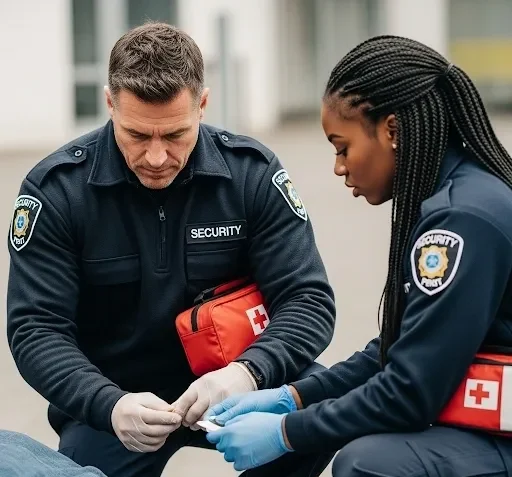
Regulated Training Designed for Real‑World Operational Demands
Emergency First Aid at Work (EFAW)
Emergency First Aid at Work Training
Emergency First Aid at Work Training provides learners with the essential skills, confidence, and practical capability to respond effectively to workplace medical emergencies. This Level 3 qualification is designed for organisations that require a trained first aider on site and for individuals operating in environments where rapid, competent intervention can prevent deterioration and save lives. The programme aligns with UK/EU First Aid Standards and National Occupational Standards, ensuring full regulatory compliance.
Duration: 1 Day / 6–8 hours
Accreditation: Emergency First Aid at Work Certificate (valid 3 years)
Aligned with: UK/EU First Aid Standards & National Occupational Standards
Pre‑requisites
- None required.
- Suitable for learners aged 16+.
- Learners must be able to kneel, perform chest compressions and practical tasks.
Core Competencies in Emergency First Aid at Work Training
This programme develops the operational capability required to manage time‑critical incidents in the workplace. Learners gain structured assessment skills, hands‑on casualty management techniques, and the ability to remain calm and decisive under pressure.
Legal Framework & First Aider Responsibilities
Learners explore the Health & Safety (First Aid) Regulations, employer obligations, and the legal responsibilities of a designated first aider. Emphasis is placed on safe practice, duty of care, infection control, and incident reporting.
Primary Survey (DRSABC)
A systematic approach to assessing an unresponsive casualty, enabling learners to identify life‑threatening conditions quickly and prioritise interventions.
- D – Danger
- R – Response
- S – Send for help (or Shout for help)
- A – Airway
- B – Breathing
- C – Circulation / CPR
Secondary Survey
A structured head‑to‑toe assessment to identify injuries, medical conditions, and developing risks.
CPR & AED (Resuscitation Council Guidelines)
Practical training in adult CPR, safe use of an Automated External Defibrillator, and management of unresponsive casualties. Learners practise compressions, rescue breaths, and AED deployment under realistic conditions.
Airway & Breathing Emergencies
- Choking (adult, child, infant)
- Seizure management
- Asthma and respiratory distress
Trauma & Injury Management
- Wound care and haemorrhage control
- Shock and internal bleeding
- Minor injuries
- Burns and scalds
- Musculoskeletal injuries
Medical Conditions
Recognition and management of common workplace medical emergencies including diabetes, epilepsy, anaphylaxis, and the safe use of auto‑injectors.
Record Keeping & Reporting
Accurate documentation of incidents, completion of workplace accident forms, and communication with supervisors and emergency services.
Learning Outcomes
By the end of the Emergency First Aid at Work Training, learners will be able to:
- Conduct a full primary survey and manage unresponsive casualties.
- Deliver effective CPR and AED interventions.
- Manage choking, seizures, and breathing‑related emergencies.
- Control bleeding and treat minor injuries.
- Recognise and respond to shock, burns, and medical conditions.
- Provide safe, structured first aid until professional help arrives.
- Record and report incidents in line with workplace requirements.
Assessment
Assessment is continuous and includes:
- Practical skill demonstrations
- Scenario‑based evaluations
- Written knowledge checks
Learners must demonstrate competence in all required areas to achieve certification.
Who Should Attend
This qualification is essential for:
- Low‑ to medium‑risk workplaces requiring a trained first aider
- Security teams
- Supervisors and managers
- Schools and childcare settings
- Construction and engineering
- Warehousing and logistics
- Hospitality and events