
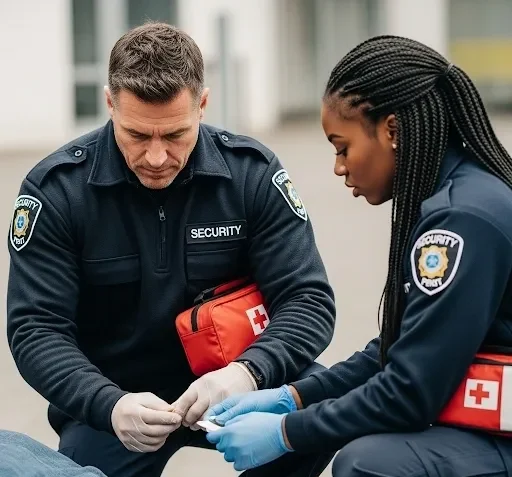
BASIC FIRST AID
Basic First Aid Training provides essential life‑saving skills including CPR, bleeding control, and emergency response.
Basic First Aid Training — Uganda & UK
A practical, focused programme that equips learners with the immediate, life-saving skills needed to respond to cardiac arrest and other critical emergencies — effective CPR across all age groups, safe use of an Automated External Defibrillator, and confident management of an unresponsive casualty until professional help arrives.
Basic Life Support & AED
- None required.
- Suitable for learners aged 16+.
- Learners must be able to kneel, perform chest compressions, and complete practical tasks.
Basic Life Support & AED syllabus
The programme builds the core response capability required to act decisively in the critical first minutes of an emergency — when rapid, competent intervention has the greatest impact on survival.
Primary Survey (DRABC)
- D — Danger: Ensure the area is safe for yourself, the casualty and others.
- R — Response: Check if the casualty responds to voice or touch.
- A — Airway: Open and maintain the airway.
- B — Breathing: Check for normal breathing for no more than 10 seconds.
- C — CPR / Call for help: If not breathing normally, call 999 or the Regional Emergency Line and begin CPR immediately.
Core Life Support Skills
- Understanding the chain of survival
- Scene assessment and safety
- CPR for adults, children and infants
- Compressions-only CPR vs standard CPR
AED Training
- Safe operation of an AED
- Pad placement
- Shock protocols
- AED troubleshooting and safety considerations
Airway & Breathing
- Airway obstruction (choking) — adult, child and infant
- Recovery position application
- Managing unresponsive casualties
Additional Content
- Post-resuscitation care
- When and how to hand over to emergency services
- Documentation and incident reporting
By the end of the course, learners will be able to:
- Perform effective CPR for adults, children and infants
- Use an AED safely and confidently
- Recognise and manage choking across age groups
- Conduct a primary survey and respond to cardiac arrest
- Stabilise an unresponsive casualty and place them in the recovery position
- Communicate effectively with emergency responders
How you’re assessed
Assessment is continuous and practical throughout the session:
Continuous Practical Assessment
Ongoing evaluation of life-support and AED skills as they’re performed.
Instructor Observation
Direct observation of skill performance against the required standard.
Built for any workplace needing rapid-response capability
This course suits anyone who may be first on the scene of a medical emergency — no prior experience needed. Typical settings include:
Related courses & guidance
Need a fuller workplace qualification, or want to verify the awarding standards behind this course?