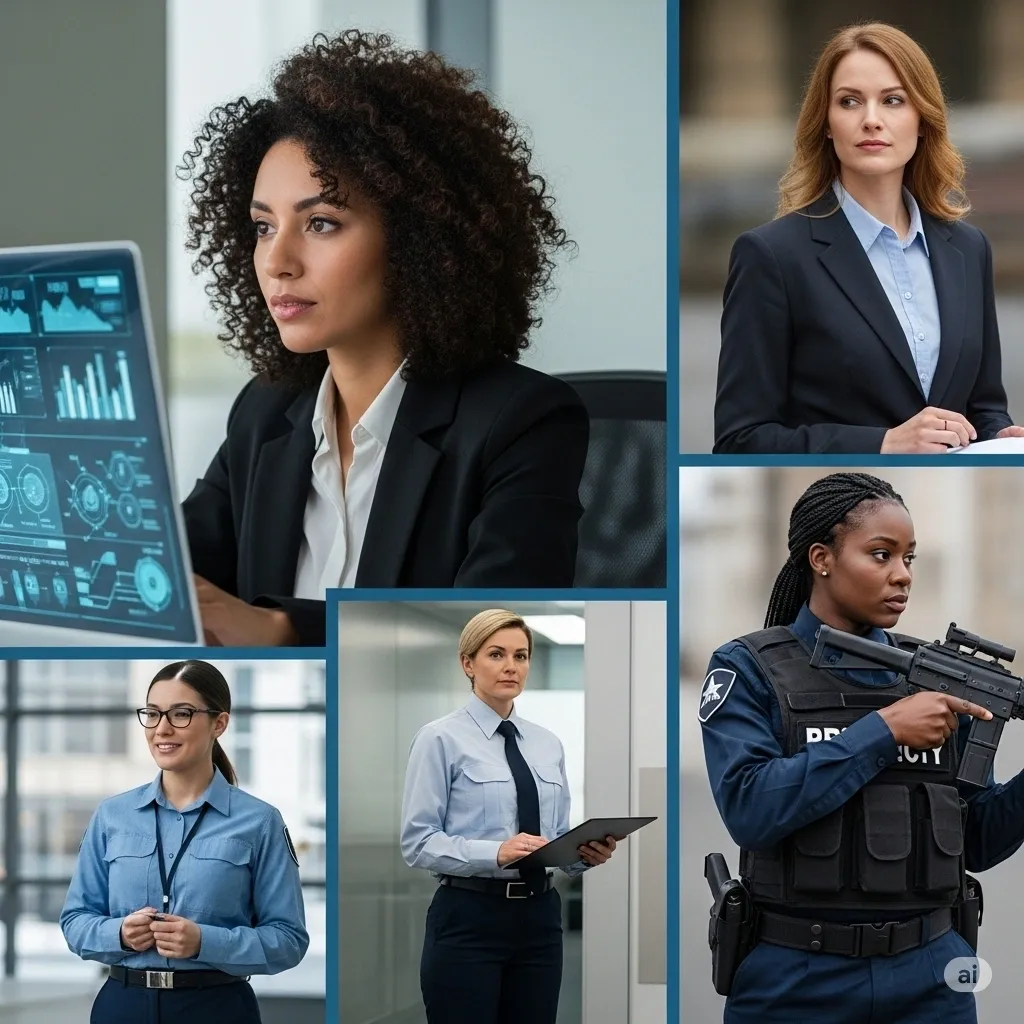
Unleashing a Hidden Powerhouse!
Why the Security Sector Needs Women, Now More Than Ever
Women in the Security Sector: Why Their Role Is Now Essential
The image of security has long been cast in shades of grey, often dominated by outdated perceptions of brute force and unwavering masculinity. But in a world riddled with evolving threats, from sophisticated cyber attacks to complex social dynamics, this narrow view isn’t just archaic – it’s a profound liability. The glaring absence of women in the security sector isn’t merely a diversity issue; it represents a massive, untapped powerhouse of talent, capability, and economic potential that industries, and indeed nations, can no longer afford to ignore.
At Britannia Elite, we don’t just recognise this reality; we are actively forging a new future for security. Our women-only courses, taught by women only, are not simply about levelling the playing field; they are about cultivating the precise skills the modern security landscape demands, unequivocally proving the immense value of a gender-diverse force.
The Stark Reality: A Global Gender Gap
Let’s confront the numbers. While precise figures vary across sub-sectors – from physical guarding to cutting-edge cybersecurity – the overall picture reveals a stark underrepresentation of women:
- United Kingdom: As of September 2024, women comprise a mere 10.97% of SIA-badged (Security Industry Authority licensed) professionals. That’s just over 48,000 female licence holders out of nearly 440,000. In frontline roles like door supervision, the disparity is even more pronounced. This isn’t just a statistic; it’s a critical shortage right here at home, hindering our collective security efforts.
- United States: Across the broader security industry, women hold approximately 22.5% of leadership roles and about 24.9% of security guard positions. In the critical field of cybersecurity, women account for a global average of 22% of security teams as of 2024, with the U.S. slightly lower at 19.2%. Disturbingly, a 2024 ISC2 survey found that 16% of security teams reported having no women whatsoever. This glaring gap means a significant portion of talent remains on the side-lines, critically impacting digital defences.
- Africa: Comprehensive pan-African statistics remain elusive, yet the broader “Women, Peace and Security” agenda underscores significant underrepresentation. The Africa Gender Index 2023 noted women score only 50.3% in equality across economic, social, and public representation. While the need for women in African-led peace support operations is recognised, actual female representation often lags. For example, some missions report just 27% female military observers in Liberia and 17.8% in Ghana (as of 2022-2023 data points). This highlights a colossal, ongoing disparity in formal security structures across a continent vital to global stability.
- Asia: The challenges are equally severe. In the Asia-Pacific region, women represent as little as 14% of cybersecurity professionals under 30. UN Women reports less than 10% female representation in the overall cybersecurity workforce across Asia and the Pacific. Deeply ingrained societal expectations and limited access to female-focused education and training are formidable barriers, hindering progress in one of the world’s most dynamic regions.
These statistics aren’t just figures on a page; they represent millions of untapped brilliance, strategic insights, and essential skill sets currently being squandered in an industry vital to global stability.
The Invisible Chains: Why Women Are Held Back
Beyond the raw numbers, the insidious underlying causes persist:
- The Tyranny of the Clock: Many security roles demand gruelling, irregular, and often unsocial hours. From relentless night shifts to extended deployments at major events, these schedules fundamentally clash with caregiving responsibilities that, demonstrably, fall disproportionately on women. Arranging reliable childcare or eldercare for erratic shifts becomes a logistical nightmare, forcing countless talented women to abandon their career aspirations. This isn’t a lack of commitment; it is a systemic failure to provide flexible, supportive work environments.
- The Unseen Bias: Beyond overt discrimination, insidious unconscious biases in recruitment and promotion subtly disadvantage women. Assumptions about physical capabilities, leadership styles, or even willingness to deploy, inadvertently shunt opportunities away from highly capable female candidates.
- Lack of Visible Role Models: The shocking underrepresentation creates a pernicious cycle. If young women don’t see themselves reflected in the industry, they are far less likely to envision a viable career path within it.
Beyond Brawn: The Indispensable Contributions Women Unleash
The security of tomorrow is not defined by physical deterrence alone; it’s increasingly about acute intelligence, advanced technology, nuanced communication, and profound human understanding. Here’s what women bring to the table – not as a ‘nice-to-have’, but as indispensable components of a robust, modern security strategy:
- Mastery of De-escalation and Conflict Resolution:
- The Edge: Women are often perceived as more approachable and less immediately threatening, making them uniquely effective at diffusing volatile situations before they erupt. Their communication styles frequently prioritise negotiation and understanding over confrontation.
- The Proof: Countless real-world scenarios unequivocally demonstrate that female security operatives can de-escalate aggressive individuals, particularly men, who might be more inclined to physically challenge a male counterpart. This leads to fewer violent outcomes, safer environments, and significantly reduced legal liabilities.
- Unparalleled Communication & Interpersonal Acumen:
- The Edge: Empathy, active listening, and rapport-building are areas where women consistently excel. These are not ‘soft’ skills; they are critical intelligence-gathering tools, essential for interviewing, crisis management, and forging public trust.
- The Proof: In public-facing roles, investigations, or close protection, a female presence can foster comfort and openness, especially when dealing with vulnerable individuals, women, or children. Crucially, in many cultures and regions, particularly across Africa and Asia, a female security professional is not just preferred but mandated for roles involving interaction with women – such as searches, personal protection for female clients, or ensuring privacy in sensitive environments. This undeniable demand underscores the strategic necessity of female operatives for international assignments and culturally sensitive operations.
- Diverse Perspectives, Superior Solutions:
- The Edge: Homogenous teams breed dangerous blind spots. A gender-diverse workforce brings a wider array of viewpoints, problem-solving approaches, and insights, leading to more comprehensive risk assessments and truly innovative security protocols.
- The Proof: From cybersecurity to strategic planning, rigorous research consistently shows that diverse teams decisively outperform their uniform counterparts in creativity, resilience, and overall effectiveness. Women identify different threats and propose unique solutions that all-male teams might simply overlook.
- Enhanced Public Comfort and Trust:
- The Edge: The mere presence of female security personnel can make environments feel immeasurably safer and more inclusive for everyone, particularly other women and children.
- The Proof: In venues ranging from airports and schools to bustling nightclubs and private residences, female guards fulfil critical needs, legally and practically. The ability to conduct searches on female patrons or provide close protection for high-net-worth female clients without cultural or comfort barriers is a growing, undeniable demand that the industry must meet.
- Attention to Detail and Multi-tasking:
- The Edge: Often observed to possess exceptional organisational skills and the innate ability to manage multiple complex tasks simultaneously under pressure.
- The Proof: These attributes are profoundly beneficial in surveillance, monitoring, and administrative security roles where meticulousness and the capacity to process multiple streams of information concurrently are paramount.
- The Human Element: Fostering Psychological Safety and Empathy
- The Edge: Beyond tangible skills, women often play a pivotal role in humanising team dynamics. Their presence profoundly fosters greater emotional intelligence, empathy, and psychological safety within a group. This translates into creating an environment where team members feel genuinely comfortable expressing ideas, asking questions, and even admitting mistakes without fear of judgment.
- The Proof: Psychologically, teams with greater gender diversity consistently exhibit higher levels of collective intelligence and perform better, partly because they benefit from enhanced psychological safety.
- When team members, irrespective of gender, feel secure enough to be vulnerable and authentic, it unleashes richer collaboration, more open communication, and ultimately, more effective and resilient problem-solving. This makes the team not just a functional unit, but a truly cohesive, supportive, and powerfully effective human collective.
- Example: In high-stress security operations, a team that prioritises empathy and open communication – often significantly influenced by diverse perspectives – can far better support its members’ mental well-being, leading to greater resilience and preventing burnout. This “human touch” can be the decisive factor between a merely functional team and a truly high-performing one.
Britannia Elite: Forging the Future of Security
This isn’t merely theory for us. At Britannia Elite, we are actively cultivating this massive untapped power. Our women-only security courses, delivered exclusively by experienced female instructors, are meticulously designed to:
- Empower: Provide a supportive, confidence-building environment, free from the gender biases sometimes encountered in mixed training.
- Equip: Instil all the core competencies – from strategic planning to advanced de-escalation techniques, and physical security to critical incident management – all tailored to the unique strengths and unparalleled opportunities for women in the industry.
- Exemplify: Forge a new generation of elite female security professionals, ready to command critical roles where their skills are not just valued, but absolutely essential.
The security sector is not just about physical deterrence; it’s about acute intelligence, advanced technology, nuanced communication, and profound human understanding. By consciously dismantling systemic barriers and proactively embracing the distinct and powerful contributions of women, we don’t just achieve gender equality. We unleash a dynamic, innovative, and vastly more effective security force, truly capable of protecting us all in an increasingly complex world.
This isn’t just a niche issue for security. It’s a blueprint for maximising potential across every industry. The world desperately needs this untapped power. Britannia Elite is helping to unleash it.
Our Protective Security Operator Programme further develops these operational strengths – ATHENA.
For broader context, UN Women provides recognised international guidance on gender and security UN.