COMAH Watch
Anatomy of a High-Hazard Security Operation
To say that security on a Top-Tier COMAH (Control of Major Accident Hazards) site is a high-stakes role is a dangerous understatement. It is not a job; it is a legally mandated function, a critical layer of protection in the defence against catastrophe. The real title for these professionals is not ‘Security Officer’ but Catastrophe Prevention Specialist.
Here, inside the wire of the oil refineries, gas terminals, and chemical plants that form our industrial backbone, security is woven into the very fabric of the Process Safety Management system. Under the COMAH 2015 Regulations, every procedure, every patrol, and every decision is part of a “Safety Case” submitted to the regulator—a promise that the immense, volatile power contained within the facility is under absolute control. A lapse in security is not just a breach; it’s a direct threat to the integrity of that promise, with consequences that can span miles and last for generations.
The Control Room: The Integrated Nerve Centre
The sterile, quiet atmosphere of a COMAH control room belies the intense activity within. This is the site’s nerve centre, and the operator is far more than a simple CCTV monitor. They are a Process Safety Analyst managing an integrated suite of systems, cross-referencing thermal camera feeds, access control logs, and digital Permits-to-Work to spot the precursors to disaster. They are the first, calm voice of authority during an incident, managing notification systems and providing a running commentary to the incident commander.
The 24/7 Patrol: The Corporeal Sensor Array
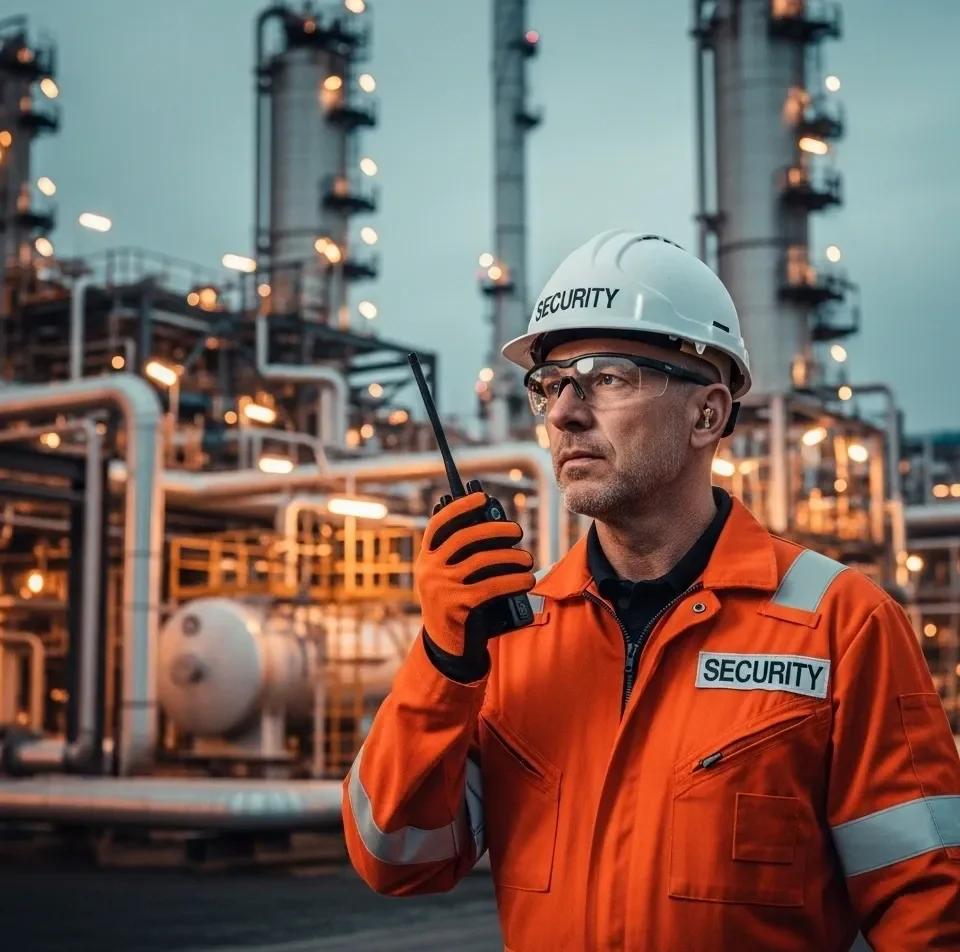
The 24/7 patrol is a systematic, mobile audit of the plant’s physical integrity. The officer is a Human Sensor Array, using their own senses—backed by sophisticated equipment—to detect failures that automated systems might miss. Following precise routes, they conduct physical checks on safety equipment, containment bunds, and fence lines. They are trained to identify hazards by sight, sound, smell, and even touch, feeling for the excessive vibration of a failing pump or spotting the tell-tale frost of a cryogenic leak.
The External Threat: Sabotage and Ideological Activism
Beyond the internal risks of process failure, COMAH sites face a constant and evolving external threat from those with malicious or ideological intent. The security operation is the primary defence against human adversaries seeking to cause harm. This includes managing protest situations where activists may unknowingly endanger themselves by entering hazardous areas, and maintaining constant vigilance against sabotage, looking for subtle signs of tampering that could precipitate a catastrophic failure.
Beyond the Badge: The Security Professional’s Matrix of Qualifications
An SIA licence is merely the key to the gate; it is the absolute bare minimum and proves nothing of an individual’s ability to operate in this environment. To be deemed competent, the on-site security professional must hold a verifiable portfolio of advanced safety and emergency response qualifications. This is their true ticket to work, including certifications like the CCNSG Safety Passport, IOSH Managing Safely, First Aid at Work (FAW/FPOS), Fire Watch, Confined Space Awareness, and often Breathing Apparatus (BA) Wearer certification for team leads and ERT members.
The Command Structure: The Chain of Legal Accountability
On a COMAH site, the security team’s hierarchy is a legally-defined chain of accountability built upon this foundation of competence. The Gate Officer executes process safety controls. The Out-of-Hours Team Lead, drawing on their advanced training, assumes the mantle of Senior Authority on Site. The Supervisor or Manager acts as an auditor of the entire security-safety interface, legally accountable for the verifiable competence of their team.
The Sharp End: Incident Command and Control
When an alarm sounds, the security team’s role transforms from preventative monitoring to active incident command. Their accountability is immediate and absolute.
Initial Coordination: The Control Room operator executes the initial emergency plan, triggering alarms and sending out mass notifications. Simultaneously, the out-of-hours Team Lead becomes the de-facto Initial Incident Commander. They establish a command post, acting as the single point of contact and coordinating the actions of the on-site team while liaising directly with senior site leads (engineers and managers), providing them with the critical information needed to initiate partial or full plant shutdown procedures.
Emergency Services Interface: The security team is the interface for all responding emergency services. They take immediate control of all site access and egress. An officer is dispatched to man the pre-determined Rendezvous Point (RV Point). This officer is not simply a guide; they are the provider of the initial METHANE report to the first arriving Fire & Rescue crew commander:
- M – Major Incident declared.
- E – Exact Location.
- T – Type of incident (fire, leak, explosion).
- H – Hazards (known chemicals, wind direction, structural instability).
- A – Access (safest routes to the scene).
- N – Number of casualties.
- E – Emergency services required.
- Access Control and Logging: While the RV Point is being managed, the Gate Officer’s role shifts. They cease all non-essential traffic and are responsible for logging every single responding emergency service vehicle, crew member, and piece of equipment entering the site. This log is critical for maintaining accountability of all personnel within the cordon. Security will often provide an escort to guide responders via safe routes, ensuring they are not inadvertently exposed to other plant hazards on their way to the scene.
The Crucible of Competence: Relentless Training and Drills
These complex incident command responsibilities are not left to chance. They are forged in the crucible of realistic, high-pressure drills. These are not simple fire drills. They are complex, multi-agency simulations of worst-case scenarios: a toxic gas release, a perimeter breach by hostile actors, or a full-scale industrial fire. These drills, often run with local police and fire services, test every aspect of the emergency plan—from the METHANE report at the RV Point to the handover of command—ensuring the security team can perform their critical functions flawlessly under the most extreme pressure imaginable.
Ultimately, the role of security on a COMAH site has little to do with traditional guarding. It is an intellectual, physical, and psychological commitment to prevention against threats both accidental and deliberate, underpinned by a matrix of advanced qualifications and proven through high-stakes incident command. They are not just guards; they are one of the most critical components of a site’s license to operate safely.