Martyn’s Law: The Brutal Truth – Ignorance Is No Longer An Option
The Unforgiving Truth – It Took Death, Devastation, and a Mother’s Roar.
MARTYNS LAW
Let’s strip away the corporate speak, the polite ambiguities, and the convenient excuses. For too long, our pubs, our shopping centres, our places of worship, and our concert venues – the very fabric of British public life – have operated on a cocktail of dangerous optimism and utterly inadequate, inconsistent security provisions. The tragic echoes of Manchester, London Bridge, Westminster, and countless other attacks scream a fundamental truth: hoping is not a strategy. Complacency is a killer. And the bill, paid in innocent lives, has come due.
The security industry, from the seasoned veteran to the fresh-faced operative, has witnessed this reality fester. We’ve seen the relentless pressure of contracts awarded to the lowest bidder, the insidious rise of “shirt or suit fillers”—bodies in uniform, utterly devoid of the vigilance, skill, and proactive readiness demanded by a genuine threat. And for too long, those who prioritized razor-thin profit margins over genuine protection, who quietly grumbled about ‘red tape’ or ‘cost’ when lives were at stake, utterly failed to grasp the horrific reality that could, and did, unfold in our public spaces. Frankly, their opposition was rooted in an uneducated detachment from the brutal consequences of terrorism in our bars, on our streets, and in our crowded venues.
Forged in Fire: A Mother’s Unrelenting Crusade Against Inaction, Backed by a Nation’s Grief
Martyn’s Law, officially the Terrorism (Protection of Premises) Act 2025 [1], is not some abstract parliamentary decree. It is a monument carved from unimaginable grief, born from the unwavering resolve of a mother who refused to let her son’s death be in vain. On May 22, 2017, Salman Abedi murdered 22 innocent people, including Martyn Hett, at the Manchester Arena. What followed was not just a tragedy; it was a damning indictment of a system that lacked mandatory, consistent protective security, leaving the public vulnerable and exposed.
Enter Figen Murray OBE. This extraordinary woman, Martyn’s mother, launched a relentless campaign that transcended personal grief, evolving into a national imperative. Her fight for Martyn’s Law wasn’t a solitary lament; it was a rallying cry for all those deeply scarred by terrorism in the UK. She received unwavering backing from bereaved families from Manchester and other attacks, families who understood all too intimately the devastating price of inaction.
Their collective voices, echoing the pain of Brighton, Enniskillen, Canary Wharf, Omagh, and the indelible scars of 7/7, formed an unstoppable force. Figen Murray OBE (www.figenmurray.co.uk) became the tireless, articulate, and utterly compelling voice of a national demand for safety that could no longer be ignored.
Her incredible 200-mile walk from Manchester to Downing Street in May 2024 [2], seven years after the bombing, wasn’t a PR stunt. It was a visible, visceral demand for accountability, sustained public pressure that finally shattered the inertia of what should have been adequate professional security. For those who opposed this legislation, who dismissed it as bureaucratic overreach or an economic burden – you simply weren’t there. You never had to pick through the debris, piece by piece, grappling with the unthinkable reality that happens in our own communities. Your opposition, whether intended or not, was a tacit endorsement of continued vulnerability.
The Grim History: When Public Spaces Became Unseen Battlegrounds, Marked Deeply in the British Psyche
To grasp the absolute necessity of Martyn’s Law, one must look unflinchingly at the UK’s chilling history of terrorism. This isn’t just about headline-grabbing attacks on major infrastructure; it’s about the ordinary spaces where we gather, places now marked deeply in the British psyche.
From the Birmingham Pub Bombings of 1974 – which ripped through central pubs, killing 21 and injuring hundreds, an atrocity still unresolved – to the relentless IRA campaigns, through the 7/7 London bombings that brought terror to our transport network, to the recent horrors of London Bridge and Westminster. These attacks weren’t aimed at military bases; they were aimed at us, the public, living our lives. Each incident left its own indelible scar, a collective trauma that underscored the fragmented and inconsistent nature of our protective measures.
Prior to Martyn’s Law, the responsibility for securing these spaces relied heavily on security personnel, often operating under severe constraints. While the Private Security Industry Act 2001 (PSIA 2001) [4] and the SIA’s licensing regime (now boasting over 500,000 active licence holders in the UK) [5] provided a baseline for individual operatives, it failed to mandate a unified protective standard for the premises themselves.
This created glaring, exploitable vulnerabilities – a security lottery where your safety depended on the varying commitment and, critically, the budget allocated by individual venue owners for their security teams. Those who opposed mandatory measures were, wittingly or unwittingly, arguing for the continuation of this dangerous, deadly gamble.
They lacked a fundamental understanding of the insidious nature of modern terrorism and the devastating effects it had already wrought on public spaces.
The Unforgiving Verdict: Where Security Failed to Play Its Part at Manchester Arena
The Manchester Arena Inquiry, led by Sir John Saunders, delivered a devastatingly clear and unflinching verdict on the security failures that contributed to the tragic loss of 22 lives and countless physical and unseen psychological injuries.
It wasn’t a single point of failure, but a catastrophic confluence of systemic weaknesses, individual errors, and a pervasive lack of effective coordination and communication within the security apparatus. The security industry, both the contracted firms and individual operatives, found itself directly in the crosshairs.
- Critical Missed Opportunities on the Night: Security personnel had multiple opportunities to intervene with Salman Abedi, who loitered suspiciously for an hour in a CCTV blind spot. Junior officers, despite having a “bad feeling,” failed to act or escalate, hampered by inadequate training, a lack of clear protocols, and fear of being labelled “racist.” Communications were disastrously broken down, leaving critical warnings unheard. This wasn’t a lapse by isolated individuals; it was a failure within the professional structure that was ostensibly there to protect [3].
- Systemic Organisational and Management Failures: The Inquiry exposed “complacency” at the top levels of both the arena operator (SMG) and the contracted security provider (Showsec). A relentless focus on “keeping costs down” and “remaining competitive” directly led to under-resourcing, inadequate training (focused on “tick-box” compliance over real-world competence), and a stark lack of counter-terrorism expertise. Risk assessments for terror attacks were “clearly flawed” [3].
- Wider Failures: Even outside private security, the Inquiry highlighted “significant missed opportunities” by MI5 to act on intelligence related to Abedi prior to the attack. This underscores a broader failure to connect the dots across the security landscape [3].
The Inquiry’s findings explicitly called for a statutory approach – a “Protect Duty” – because the existing system of security, often woefully undervalued and under-resourced, was “wholly inadequate” [3]. The industry’s internal shortcomings – the cost-cutting, the complacency, the inadequate training, and the reliance on “shirt fillers” – made legislation not just advisable, but unavoidable. The industry had to be compelled to act, because a significant portion of it demonstrably failed to do so adequately when lives were on the line.
The Great Reset: Martyn’s Law and the New Era of Accountability
Now, the landscape has fundamentally shifted. Martyn’s Law is not a suggestion; it is the law of the land, receiving Royal Assent on April 3, 2025 [1]. It mandates what was once merely advised.
- Core Objective: To improve protective security and organisational preparedness at publicly accessible premises and events, ensuring they are ready to keep people safe in the event of a terrorist attack [1].
- Standard Tier (200-799 capacity): Your local pub, village hall, or mid-sized shop. The demands here are foundational: low-cost activities focused on procedures, staff training, and awareness. Think basic counter-terrorism awareness training (like the free ACT e-learning), clear evacuation plans, knowing how to lock down areas, and identifying safe routes. This isn’t about fortress building; it’s about basic, life-saving awareness [1].
- Enhanced Tier (800+ capacity): This targets larger venues and events – stadiums, major concert halls, large shopping centres. Here, the requirements are more stringent, involving detailed risk assessments, proactive physical security measures (e.g., bag searches, CCTV, hostile vehicle mitigation), and robust security plans. The “reasonably practicable” clause applies here – measures must be proportionate to the specific risk and resources, but the expectation is that they will be implemented [1].
- “Reasonably Practicable” (Industry Correct Nuance): This critical legal concept means responsible persons must take steps proportionate to the risk, considering the nature of the premises and available resources. It’s not a “one-size-fits-all” but demands genuine, demonstrable consideration and action, removing any ambiguity for inaction [1].
Crucially, the Security Industry Authority (SIA) is now the designated regulator for Martyn’s Law [1, 6]. This is a seismic shift, an expansion of their remit that gives them genuine power. The SIA won’t just be advising; they will enforce. Expect compliance notices, significant monetary penalties (up to £10,000 for Standard Tier, up to £18 million or 5% of global turnover for Enhanced Tier) [6], and criminal offences for serious or repeated non-compliance. The days of inadequate security being an acceptable solution are well and truly dead.
The 24-month implementation period from Royal Assent (April 3, 2025), meaning likely full enforcement around April 2027, provides time, but the message is clear: prepare now [1, 7]. Venues do not need to spend money on external consultants; the Home Office will publish statutory guidance, and free resources like ProtectUK are readily available [1, 9].
The Security Industry’s Fight and Your New Physical Imperative
The security industry, through its professional bodies (like ASIS, The Security Institute, BSIA) and seasoned practitioners, was deeply involved in the consultations for Martyn’s Law. We weren’t passive observers; we were active participants, providing crucial, practical feedback on the draft legislation. Yes, there were legitimate concerns about the financial burden, especially for smaller businesses and community organisations (a staggering 66% of consultation respondents disagreed with initial cost estimates) [6]. This was not opposition to the principle of safety, but a critical demand for a financially sustainable and enforceable framework. We pushed for clarity on “reasonably practicable” to ensure proportionality, preventing a situation where smaller venues faced unrealistic burdens that would simply lead to non-compliance or closure.
The Procurement Act 2023, taking effect in February 2025 [8], is another critical piece of this puzzle. By requiring public sector tenders to reflect true service costs and promote fair wages, it must finally break the cycle of lowest-bidder contracts that have crippled quality and incentivized the “shirt filler” culture. This is the opportunity for the security industry to finally demand the investment it deserves, in order to meet these heightened legal obligations. The era of expecting professional security on poverty wages, leading to compromised standards, must end in the wake of this law.
Now, for you, the security operative, your role is fundamentally redefined. You are now a critical, active, indispensable component of national protective security. If you thought being a “shirt or suit filler” was an option before, it unequivocally is not now. The stakes are too high.
What does Martyn’s Law now physically involve for you, on the ground, every single day?
- Become a Human Sensor: Proactive Vigilance: Your eyes are your primary weapon. Actively scan for individuals filming, taking notes, asking unusual questions, or loitering without purpose. This is “See, Check, Notify” (SCaN) in action – spotting the dry run before the attack. This demands constant movement, keen observation, and the ability to engage politely yet firmly. You are the first line of human intelligence.
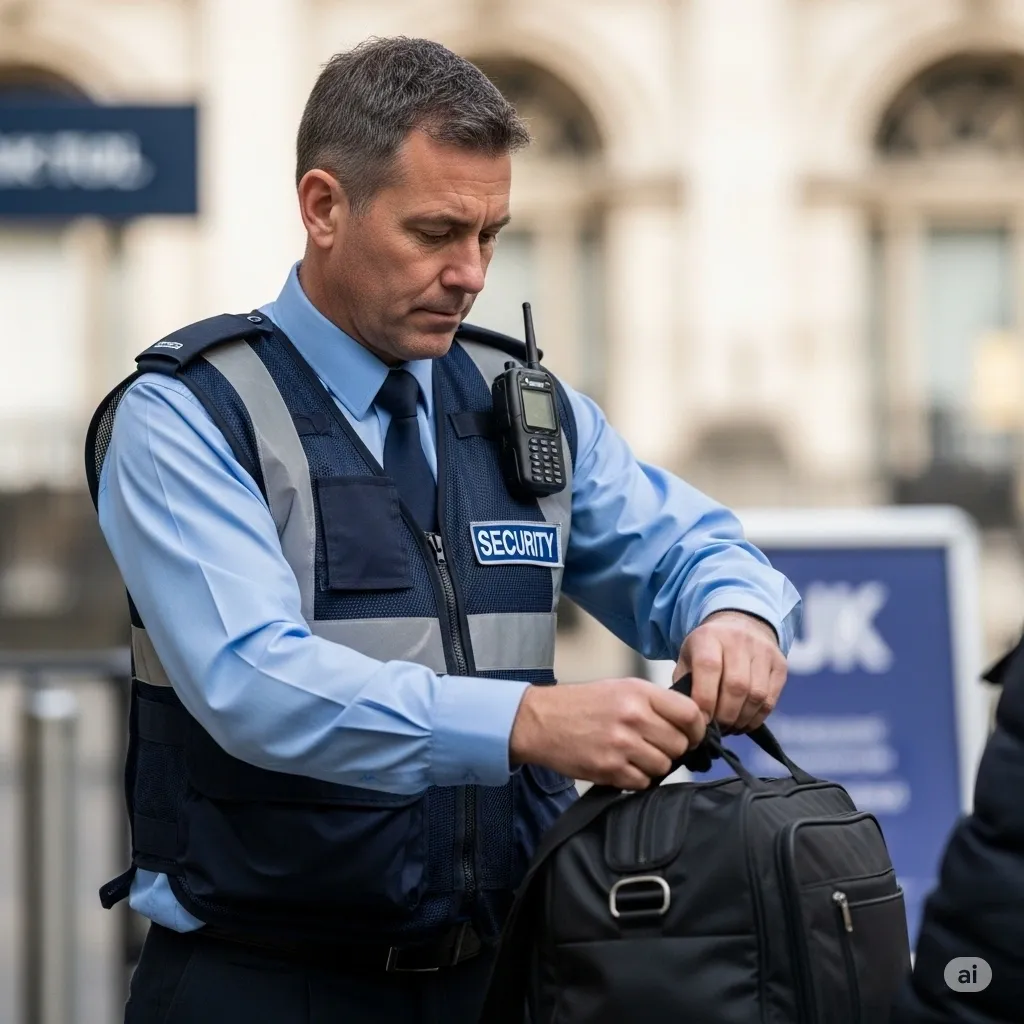
- Master Physical Measures: Hands-On Protection: For Enhanced Tier sites, this means thorough bag searches, body searches (where applicable and legal), and vehicle checks. It requires a proactive, firm, yet customer-service oriented approach to screening every person and vehicle entering the premises. You must also know how to rapidly secure doors, gates, and specific zones to delay or deny an attacker – deploying mobile barriers, closing shutters, or using physical locks under extreme pressure. Every second you can gain is a life potentially saved.
- Lead the Response: From Reactive to Life-Saving Action: You will physically guide people. Know all escape routes, muster points, and crucially, “evacuation” points (safe internal areas to shelter). This requires command, clear communication, and potentially physically directing panicked, disoriented crowds. You will be expected to apply immediate, life-saving first aid, particularly in stopping catastrophic bleeding, before paramedics can arrive. Your ability to communicate clearly and accurately under chaotic, high-stress conditions will save lives.
- Embrace Continuous Engagement: The Professional’s Ethos: Expect and demand frequent, realistic drills for evacuation, lockdown, and active threat scenarios. Your on-the-ground perspective is invaluable; you are expected to contribute to reviewing and improving security plans. This is about actively promoting a security-minded culture, politely but firmly challenging anything out of place or suspicious.
The Uncomfortable Truth: Martyn’s Law Demands Excellence
Martyn’s Law is a watershed moment. It signifies a national commitment to protecting our citizens that goes far beyond token gestures. It forces businesses to take terrorism seriously – as a tangible threat to their patrons, their staff, and their very existence.
For those who still choose to ignore this or bemoan the ‘burden’ – consider the horrifying alternative. The real burden is the preventable loss of life, the lifelong trauma of survivors, and the chilling message that our public spaces are soft targets.
Martyn’s Law is not just a piece of legislation; it is a profound statement that the lives of our public are paramount. It’s an uncomfortable, hard-hitting truth that will redefine security in the UK.
There is no turning back. Training and screening by security companies must now go far beyond a 4-day basic, first-line security operative course. Rise to it. Our collective safety, the very peace of mind that allows us to enjoy our lives, depends on your vigilance, your rigorous training, and your absolute readiness to act. The era of “shirt or suit fillers” is dead. The era of the truly professional, physically capable, and life-saving security operative has just begun.
Ready to rise to the standard Martyn’s Law demands? Britannia Elite delivers the elevated training modern security requires — explore our UK-standard professional security training, advance your team through the ILM Leadership Pathway, and equip operatives with life-saving skills via our FPOSi – First Person on Scene course. Contact us today to build a compliant, capable security operation.
Further reading: The Uncomfortable Chasm and Beyond the Badge: why training must go further than basic guarding.